Few things unsettle investors quite like a volatile market. Watching portfolio values swing wildly in a matter of days—or even hours—triggers a primal instinct to cut losses and run. But here’s the thing: the investors who have built the most wealth over time didn’t do it by avoiding volatility. They did it by understanding it.
Market volatility, by definition, refers to the rate at which asset prices rise or fall over a given period. High volatility means dramatic swings; low volatility means relative stability. Most people treat the former as a threat. Savvy long-term investors treat it as a toolkit.
This isn’t a contrarian take for the sake of it. History backs it up. Some of the greatest wealth-building opportunities in modern investing history—the 2008 financial crisis, the COVID-19 market crash of March 2020—occurred during periods of extreme market turbulence. Those who held their nerve, or better yet, leaned into the downturn, were rewarded handsomely when markets recovered. Those who sold in a panic locked in their losses permanently.
This post breaks down why market volatility creates genuine opportunities for long-term investors, how to build the risk tolerance needed to capitalize on those moments, and what smart investment risk management looks like when markets get rough.
What Actually Causes Market Volatility?
Before you can take advantage of market volatility, it helps to understand what drives it.
Volatility is rarely random. It’s caused by a combination of economic data releases, geopolitical events, interest rate decisions, earnings surprises, and shifts in investor sentiment. When uncertainty spikes—think a central bank hinting at aggressive rate hikes, or a major conflict erupting overseas—markets tend to react swiftly and dramatically.
Institutional algorithms amplify these moves. A large fund selling off a position triggers stop-loss orders across the market, which triggers more selling, which triggers more stop-losses. The cascade effect can make short-term price movements look completely disconnected from a company’s underlying fundamentals.
And therein lies the opportunity. When panic drives prices down, it often pulls down quality assets alongside the weaker ones. A well-run company with strong cash flows, loyal customers, and durable competitive advantages doesn’t suddenly become a bad business because the broader market is falling. But its stock price might temporarily suggest otherwise.
Long-term investors who can distinguish between a price drop driven by fundamentals and one driven by fear are in an extraordinary position.
Why Long-Term Investors Have a Built-In Advantage
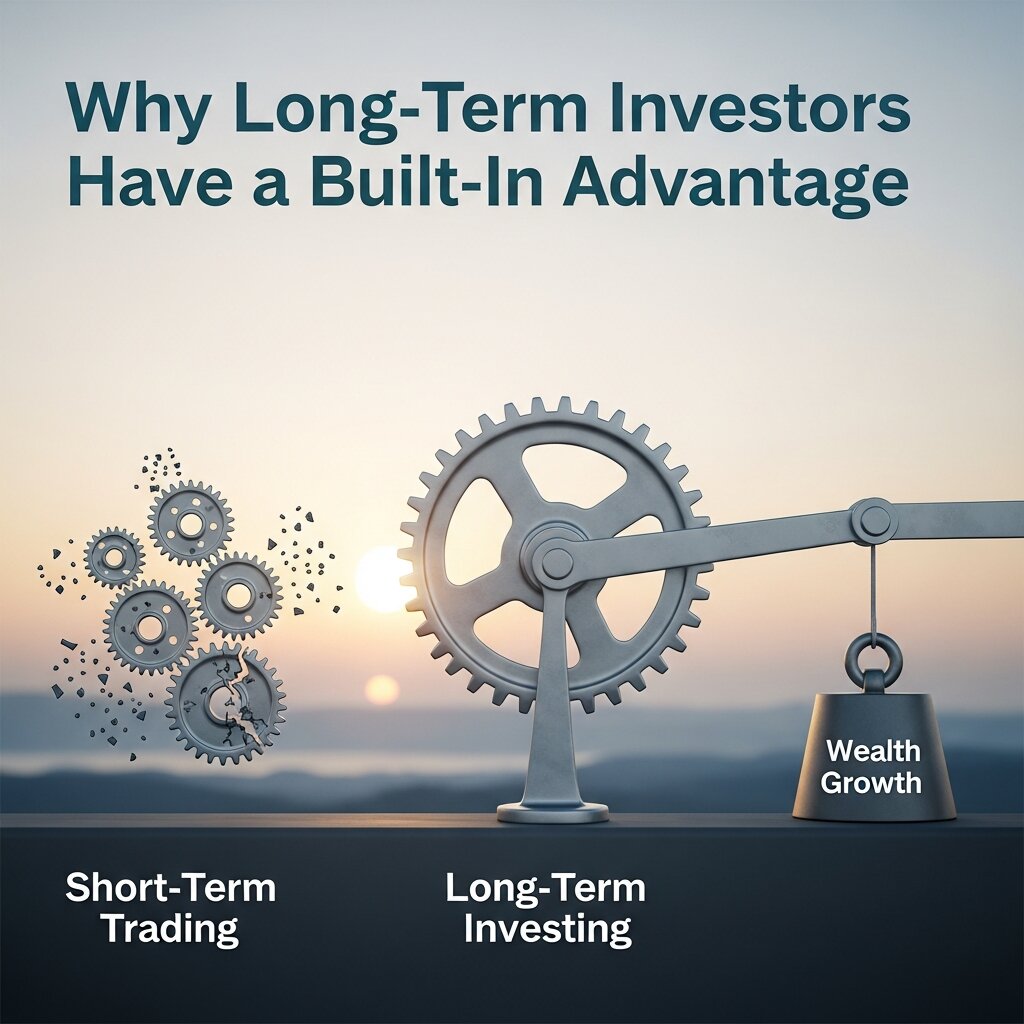 Short-term traders are at the mercy of market volatility. Long-term investors, by contrast, have the luxury of time—and that changes everything.
When your investment horizon stretches across decades rather than weeks, daily or even yearly price fluctuations become noise. The question isn’t “What will this stock do tomorrow?” but “Will this business be worth more in ten years than it is today?” For high-quality companies operating in growing industries, the answer is often yes—regardless of what happens in the next quarter.
Warren Buffett has described market downturns as sales events. The product hasn’t changed; it’s just on offer at a discount. That framing sounds simple, but emotionally, it’s genuinely difficult to execute. Human psychology is wired to treat falling prices as bad news. Overriding that instinct requires something most investors underestimate: a clearly defined risk tolerance.
How to Assess Your Risk Tolerance Before Volatility Strikes
Risk tolerance is your capacity—both financial and psychological—to endure losses without making decisions you’ll regret. It’s not static. It changes with your income, age, financial obligations, and life goals. And crucially, most people overestimate their risk tolerance until they experience a real downturn.
Assessing your risk tolerance before volatility hits is one of the most productive things a long-term investor can do. Here’s how to approach it honestly:
What is your investment timeline?
The longer your investment horizon, the more short-term volatility you can reasonably absorb. A 35-year-old investing for retirement has a very different risk profile than a 58-year-old who plans to retire in seven years. Time is a buffer—and a powerful one.
How much of a drawdown could you stomach without selling?
Be honest with yourself. A 10% drop might feel manageable in theory. But a 40% drop in your portfolio—which happened to many investors in 2008—is a very different experience. If you know you’d panic and sell at a 20% loss, that information should directly shape how you construct your portfolio.
Do you have adequate liquidity outside your investments?
Investment risk management starts before the market even opens. If you’re investing money you might need within the next two years, you’re not in a position to ride out volatility. A solid emergency fund—typically three to six months of living expenses in cash or liquid assets—is the foundation that makes long-term investing psychologically sustainable.
The Mechanics of Turning Volatility Into Opportunity
 Understanding why volatility creates opportunities is one thing. Knowing how to act on them is another.
Dollar-Cost Averaging During Market Downturns
Dollar-cost averaging (DCA) is the practice of investing a fixed amount at regular intervals, regardless of market conditions. During a volatile market, this means you automatically buy more shares when prices are low and fewer when prices are high. Over time, this lowers your average cost per share.
DCA removes the need to time the market—a task that even professional fund managers consistently fail at. Instead of agonizing over whether the market has bottomed, you invest systematically and let time do the heavy lifting.
Rebalancing to Take Advantage of Price Dislocations
Market volatility often causes portfolio allocations to drift. If equities fall sharply, your bond allocation might now represent a larger percentage of your portfolio than intended. Rebalancing—selling what’s overweight and buying what’s underweight—forces you to buy low and sell high by design.
This approach requires discipline and a clear investment policy, but it’s one of the most evidence-backed strategies in long-term investment risk management.
Identifying High-Quality Assets at Discounted Valuations
Volatility compresses valuations across the board, but it doesn’t do so equally. Some companies see their stock prices fall far more than their fundamentals justify, simply because investors are selling indiscriminately to raise cash. These dislocations are where patient, research-driven investors find their best entry points.
The key metrics to examine during a downturn include price-to-earnings ratios relative to historical averages, free cash flow yield, balance sheet strength, and competitive positioning. A business that was genuinely overvalued before a sell-off may still be expensive after a 20% drop. A fundamentally strong business that falls 35% due to market panic may represent a compelling long-term opportunity.
Investment Risk Management Strategies That Hold Up in Any Market
Capitalizing on market volatility doesn’t mean ignoring risk. The most effective long-term investors combine opportunism with rigorous risk management.
Diversification across asset classes, geographies, and sectors reduces the impact of any single downturn. When one sector collapses, another may hold steady or even appreciate. A well-diversified portfolio doesn’t eliminate volatility, but it prevents any one event from being catastrophic.
Position sizing is equally important. Even if you’ve identified a high-conviction opportunity during a market downturn, concentrating too much of your portfolio in a single name amplifies both your potential gains and your potential losses. Disciplined position sizing ensures that being wrong on one investment doesn’t derail your broader financial plan.
Reviewing your investment thesis regularly—not your portfolio balance—is a mindset shift that separates reactive investors from strategic ones. If your reason for holding a stock was its growing market share and strong management team, a 20% price drop doesn’t automatically invalidate that thesis. If it does change the fundamentals—say, a key contract was lost or management was replaced—then reassessing makes sense. But reacting to price alone is almost always counterproductive.
The Psychological Edge That Defines Long-Term Investors
 Every institutional investor, every sophisticated fund manager, and every seasoned retail investor will tell you the same thing: the hardest part of investing isn’t analysis. It’s behavior.
Market volatility exploits every cognitive bias humans have. Loss aversion makes a $10,000 loss feel worse than a $10,000 gain feels good. Recency bias makes a down market feel permanent. Herding instinct makes selling seem rational when everyone around you is doing it.
Building a structured investment plan—one that defines your asset allocation, your rebalancing rules, and your contribution schedule in advance—reduces the number of in-the-moment decisions you have to make. The more decisions you can automate or pre-commit to, the less vulnerable you are to emotional interference.
Journaling your investment rationale for each holding is another underrated practice. When volatility spikes and doubt creeps in, revisiting your original thesis can provide the clarity needed to hold steady—or confirm that something has genuinely changed.
FAQ: Market Volatility
Staying the Course Pays Off
The data on long-term investing is remarkably consistent. According to JP Morgan’s annual Guide to the Markets, missing just the ten best trading days in the S&P 500 over a 20-year period more than halves the return compared to staying fully invested. Many of those best days occur during or immediately after periods of extreme volatility.
That single statistic captures the core argument. Market volatility is not a reason to exit the market. For long-term investors with a sound strategy, a calibrated risk tolerance, and a disciplined approach to investment risk management, it’s often the best reason to stay in it—or double down.