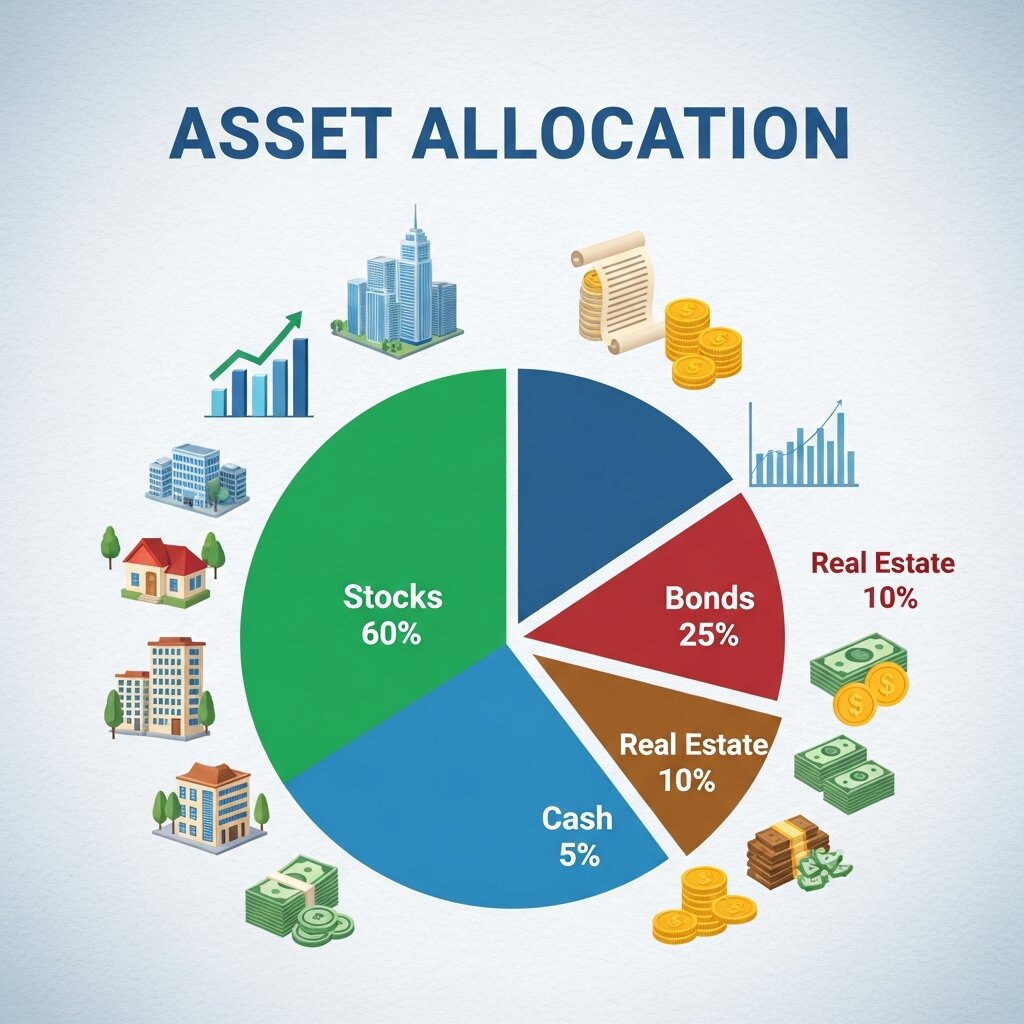
That’s exactly what asset allocation is about. It’s the practice of dividing your investment portfolio across different asset categories—stocks, bonds, real estate, cash, and more—to match your financial goals and tolerance for risk. Done well, it doesn’t just improve your chances of building wealth. It also protects you when markets turn volatile.
This post breaks down what asset allocation means, why it’s one of the most powerful tools in investment risk management, and how to build a strategy that works for your situation.
What Is Asset Allocation, and Why Does It Matter?
Asset allocation is the process of deciding how to distribute your investments across different asset classes. The most common categories are:
- Equities (stocks): Higher potential returns, higher short-term volatility
- Fixed income (bonds): More stable returns, lower risk
- Cash and cash equivalents: Maximum liquidity, minimal growth
- Real assets (real estate, commodities): Inflation protection, diversification
Each of these asset classes behaves differently under various economic conditions. When stock market investing takes a hit during a recession, bonds often hold steady or appreciate. When inflation rises, commodities tend to outperform. By spreading your money across multiple categories, you reduce the impact of any single investment performing poorly.
The reason asset allocation matters so much comes down to one key insight: diversification across asset classes has a greater impact on portfolio performance than individual security selection. A landmark study by Brinson, Hood, and Beebower (1986) found that asset allocation policy explained more than 90% of the variation in a portfolio’s returns over time. Picking the right stocks matters far less than getting your allocation right.
How Asset Allocation Manages Investment Risk
 Investment risk management isn’t about eliminating risk—it’s about taking on the right risks for your situation. Asset allocation helps you do that in a few distinct ways.
Diversification Reduces Concentration Risk
Concentration risk occurs when too much of your portfolio is tied to a single investment or sector. An investor who holds 80% of their portfolio in tech stocks, for example, is exposed to enormous downside if the technology sector crashes.
Asset allocation spreads that exposure. By holding a mix of equities, bonds, and other assets, a loss in one category is cushioned by stability or gains in another. The overall portfolio becomes more resilient.
Different Assets Respond Differently to Market Cycles
Economic cycles move through phases—expansion, peak, contraction, and recovery. Different asset classes tend to perform better or worse depending on where the economy sits in that cycle.
During expansion, equities typically thrive. During contraction, bonds and defensive assets often outperform. Holding a diversified allocation means your portfolio is never fully aligned with a single phase of the economic cycle, which smooths out returns over time.
Volatility Is Absorbed, Not Avoided
Some investors panic when they see short-term losses. Asset allocation doesn’t prevent volatility, but it reduces it at the portfolio level. A portfolio with 60% equities and 40% bonds will fluctuate far less than one that’s 100% in stocks—without sacrificing all of the long-term growth potential.
What Factors Should Determine Your Asset Allocation?
 There’s no universal “correct” allocation. The right mix depends on several personal factors.
Your Investment Time Horizon
Time horizon is arguably the most important input. If you’re 30 years away from retirement, you have time to ride out market downturns and recover from short-term losses. That means you can afford to hold a higher proportion of equities. As retirement approaches, the allocation typically shifts toward more conservative assets to preserve capital.
A common rule of thumb—though not universally applicable—is to subtract your age from 110 to determine your equity allocation. A 35-year-old investor would hold roughly 75% in stocks and 25% in bonds under this formula. That’s a starting point, not a prescription.
Your Risk Tolerance
Risk tolerance is psychological as much as it is financial. It measures how much volatility you can handle without making emotional decisions that hurt your portfolio—like selling during a downturn.
Some investors sleep soundly with a volatile, equity-heavy portfolio. Others feel anxious at even moderate fluctuations. Understanding your own risk tolerance is essential to building an allocation you’ll actually stick with during turbulent market conditions.
Your Financial Goals
A person saving for a down payment on a house in three years has entirely different needs than someone building a retirement fund over 30. Short-term goals require capital preservation and liquidity. Long-term goals can prioritize growth. Your allocation should reflect the goal you’re actually saving toward.
The Three Most Common Asset Allocation Strategies
Conservative Allocation
A conservative allocation prioritizes capital preservation over growth. It typically holds a higher proportion of bonds and cash—often 70% to 80%—with a smaller equity component. This approach suits investors with shorter time horizons or lower risk tolerance.
The trade-off is clear: conservative portfolios grow more slowly during bull markets. But they also fall less sharply during downturns, which is exactly the point.
Moderate (Balanced) Allocation
The classic balanced portfolio splits investments roughly 60% in equities and 40% in bonds. This approach has been a benchmark in investment management for decades because it offers meaningful growth potential while limiting downside volatility.
The 60/40 portfolio has faced more scrutiny in recent years as bond yields fluctuated and correlations between stocks and bonds shifted. Still, as a foundational framework for moderate investors, it remains widely referenced by financial professionals.
Aggressive Allocation
An aggressive allocation leans heavily into equities—often 80% to 100%—with minimal fixed income exposure. This strategy is suited for younger investors or those with a high risk tolerance who are focused on long-term capital growth and can afford to weather significant short-term losses.
Stock market investing in an aggressive portfolio carries more volatility, but historically, equities have delivered stronger returns over multi-decade periods than bonds or cash. The key word is historically—past performance is never a guarantee.
How to Rebalance Your Portfolio and Why It’s Essential
Over time, asset allocation doesn’t stay static. If equities outperform bonds over several years, your portfolio may drift from a 60/40 split to 75/25—increasing your risk profile without you making a deliberate choice.
Rebalancing is the practice of periodically adjusting your holdings back to your target allocation. This typically involves selling assets that have grown beyond their intended weight and buying those that have fallen below it.
There are two common approaches:
- Calendar-based rebalancing: Review and adjust the portfolio on a fixed schedule—quarterly or annually.
- Threshold-based rebalancing: Trigger a rebalance when any asset class drifts more than a set percentage (often 5%) from its target.
Rebalancing keeps your investment risk management strategy aligned with your goals. It also introduces a degree of discipline—essentially forcing you to buy low and sell high, which runs counter to emotional impulses during volatile markets.
Asset Allocation Across Different Life Stages
 Asset allocation isn’t a set-and-forget decision. It should evolve as your life circumstances change.
In your 20s and 30s, time is your greatest asset. A longer horizon allows you to take on more equity exposure and recover from market downturns. This is the time to prioritize growth, even at the cost of short-term volatility.
In your 40s and early 50s, the balance begins to shift. You may start gradually reducing equity exposure and increasing fixed income holdings to protect accumulated wealth. It’s also a good time to revisit your goals and update your allocation to reflect any major life changes—marriage, children, or a shift in career.
Approaching and entering retirement, capital preservation becomes the primary concern. Income stability matters more than growth. A larger proportion in bonds, dividend-paying stocks, and cash ensures your portfolio can support withdrawals without being devastated by a sharp market correction at the wrong time.
Common Mistakes to Avoid in Asset Allocation
Even investors who understand asset allocation make mistakes in practice. Here are the most common ones.
Emotional reallocation: Shifting your allocation in response to short-term market news—panic-selling during a downturn, or over-investing in equities after a strong rally—undermines the discipline that makes the strategy work.
Ignoring correlation shifts: In times of financial stress, asset classes that historically moved independently can become more correlated. Relying too heavily on the assumption that bonds always offset equity losses can leave a portfolio more exposed than expected.
Neglecting to rebalance: Allowing portfolio drift to go unchecked over years can significantly alter your actual risk profile. Regular rebalancing is not optional—it’s an ongoing responsibility.
Overlooking fees and tax implications: Rebalancing has costs. Selling appreciated assets may trigger capital gains taxes. Factor these into your rebalancing decisions, especially in taxable accounts.
FAQ: Asset Allocation
1. What is asset allocation?
Asset allocation is the strategy of dividing your investment portfolio among different asset classes—such as stocks, bonds, cash, and real estate—to balance risk and potential returns according to your financial goals.
2. Why is asset allocation important?
Asset allocation helps reduce portfolio risk, smooth returns during market fluctuations, and improve the likelihood of achieving long-term financial goals by diversifying investments across multiple asset classes.
3. What are the main asset classes used in asset allocation?
The primary asset classes are equities (stocks), fixed income (bonds), cash and cash equivalents, and real assets such as real estate and commodities. Each offers different levels of risk and return.
4. How does asset allocation help with investment risk management?
By spreading investments across assets that react differently to economic conditions, asset allocation reduces concentration risk and minimizes the impact of poor performance in any single investment category.
5. How do I determine the right asset allocation for me?
Your ideal allocation depends on factors such as your age, investment timeline, financial goals, income needs, and personal tolerance for risk. Younger investors often choose more aggressive allocations, while retirees typically prioritize stability.
6. What is the difference between asset allocation and diversification?
Asset allocation refers to dividing investments among broad asset classes, while diversification involves spreading investments within each asset class to reduce exposure to individual securities or sectors.
7. How often should I rebalance my portfolio?
Most investors rebalance their portfolios annually or whenever their allocation drifts significantly from their target percentages. Regular rebalancing helps maintain your intended risk level.
8. What is a conservative asset allocation strategy?
A conservative strategy focuses on preserving capital by allocating a larger portion of the portfolio to bonds and cash, with a smaller percentage invested in stocks.
9. Can asset allocation guarantee investment returns?
No. Asset allocation cannot guarantee profits or eliminate losses. However, it is a proven strategy for managing risk and improving the consistency of returns over the long term.
10. Does asset allocation change over time?
Yes. Asset allocation should evolve as your financial goals, life circumstances, and risk tolerance change. Regular reviews ensure your portfolio remains aligned with your long-term objectives.
Build the Portfolio That Works for You
Asset allocation isn’t a complex formula reserved for institutional investors. It’s a practical, evidence-backed framework that any investor can apply. By matching your investment mix to your goals, time horizon, and risk tolerance—and maintaining that discipline through regular rebalancing—you give yourself the best possible foundation for long-term financial success.
The goal of investment risk management isn’t to avoid market volatility entirely. It’s to ensure the level of risk you carry is intentional and appropriate for where you are in life. Start by assessing your current portfolio. Does it reflect your actual goals? If not, that’s your first step.