
Every business decision you make is only as good as the information behind it. Launch a product without understanding your audience, and you’re essentially guessing. Enter a new market without studying the competition, and you risk expensive, avoidable mistakes. Market analysis eliminates much of that uncertainty—giving businesses the data-driven foundation they need to move with confidence.
Whether you’re a startup mapping your first go-to-market strategy or an established company eyeing a new segment, market analysis is the process that transforms raw data into genuine strategic insight. It tells you who your customers are, what they need, and how your competitors are positioned to serve them. Done well, it doesn’t just inform your decisions—it shapes them.
This post breaks down exactly what market analysis involves, why it matters, and how to conduct one that genuinely moves your business forward.
What Is Market Analysis?
Market analysis is the process of gathering, interpreting, and applying data about a specific market—its size, trends, customer segments, and competitive landscape. The goal is to develop a clear, evidence-based picture of the environment your business operates in (or plans to enter).
A thorough market analysis typically covers:
- Market size and growth trends — How big is the opportunity, and is it expanding or contracting?
- Target customer profiles — Who are your ideal customers, what do they want, and how do they make purchasing decisions?
- Competitor landscape — Who else is in the space, how are they positioned, and where are the gaps?
- Industry dynamics — What external forces—economic, regulatory, technological—are shaping the market?
Market analysis isn’t a one-time exercise. Markets shift, customer preferences evolve, and new competitors emerge. The businesses that stay ahead are those that treat market analysis as an ongoing discipline, not a box to check before launch.
Why Market Analysis Matters for Business Strategy
 The most compelling reason to invest in market analysis is simple: it reduces risk. Entering a market without reliable data is one of the most common reasons businesses fail. A well-executed analysis helps you allocate resources more effectively, identify the right customers to target, and position your offering where it has the best chance of succeeding.
This principle extends well beyond traditional business strategy. In stock market investing, for example, investment risk management relies heavily on thorough market analysis. Investors who understand market trends, competitive dynamics within industries, and macroeconomic signals are far better positioned to make sound decisions than those relying on intuition alone. General investment authority—the credibility and expertise that serious investors build over time—is grounded in the habit of rigorous market research.
For businesses, the benefits are equally concrete:
- Sharper targeting: Market analysis reveals exactly who your customers are, allowing you to craft messaging and products that genuinely resonate.
- Smarter positioning: Understanding competitors helps you differentiate your offering in ways that matter to buyers.
- Better forecasting: Trend data and market sizing give your financial projections a solid factual base.
- Lower risk: Identifying potential threats early—whether from competitors, regulation, or shifting demand—gives you time to adapt.
How to Conduct a Market Analysis
Step 1: Define the scope of your analysis
Before diving into research, get specific about what you’re trying to understand. Are you exploring a new geographic market? Launching a new product line? Assessing whether demand exists for a new service? The scope of your question determines the type of data you need and how deep you should go.
Broad, unfocused market analysis tends to produce interesting observations but limited actionable insights. Tight, well-defined questions produce findings you can actually use.
Step 2: Understand your target customers
Customer understanding is the heart of any market analysis. Without a clear picture of who you’re serving, every other element of your strategy—pricing, distribution, messaging—becomes guesswork.
Start by segmenting the market. Customers can be grouped by demographics (age, income, location), psychographics (values, lifestyle, attitudes), behavioral patterns (purchase frequency, brand loyalty), or needs-based criteria (what problem they’re trying to solve).
Then go deeper. Surveys, interviews, and focus groups give you qualitative insight into how customers think and what drives their decisions. Customer reviews—both yours and your competitors’—are an underutilized goldmine. They reveal exactly what people love, what frustrates them, and what they wish existed.
Key questions to answer:
- What problem is this customer trying to solve?
- What does the buying decision process look like for them?
- What do they currently use, and what do they wish were better about it?
- What would make them switch from one provider to another?
The answers to these questions don’t just inform product development—they directly shape how you communicate your value proposition.
Step 3: Analyze your competitors
Competitor analysis is one of the most practically valuable components of market analysis. It shows you not only who you’re up against, but how the market is currently being served—and where the unmet needs lie.
Begin by mapping the competitive landscape. Identify direct competitors (those offering the same type of product or service), indirect competitors (those solving the same problem in a different way), and potential future entrants (companies with the capability and motivation to enter your space).
For each major competitor, assess:
- Product or service offering — What do they offer, and how is it differentiated?
- Pricing strategy — Are they positioned as a premium, mid-market, or budget option?
- Target audience — Who are they going after, and how does that compare to your target?
- Marketing and messaging — How do they describe their value proposition? What channels do they use?
- Strengths and weaknesses — Where are they excelling, and where are customers frustrated?
Online reviews, social media, job listings, press releases, and industry reports are all useful sources for building this picture. Tools like SEMrush or SimilarWeb can reveal digital marketing strategies, traffic sources, and keyword positioning.
The goal isn’t to copy what competitors are doing—it’s to identify the whitespace. Where is there genuine unmet demand? What customer frustrations are consistently surfacing but going unaddressed? That’s where your differentiation lives.
Step 4: Assess market size and growth potential
Understanding the size of a market helps you gauge the opportunity—and determine whether it’s worth pursuing. There are several ways to estimate market size:
- Top-down analysis: Start with the total addressable market (TAM) and work down through the serviceable addressable market (SAM) to your realistic share.
- Bottom-up analysis: Estimate based on the number of potential customers multiplied by expected purchase value.
- Comparables: Use data from similar markets or geographies that are more mature.
Growth trends matter as much as absolute size. A small market that’s growing rapidly can be more attractive than a large market that’s stagnant or declining. Pay attention to where investment is flowing, which companies are attracting funding, and what industry analysts are projecting.
This is particularly relevant in stock market investing, where understanding market growth dynamics helps investors identify sectors with long-term upside potential. Strong investment risk management practices require the same disciplined approach to market sizing and trend evaluation that savvy business strategists use.
Step 5: Identify market trends and external forces
No market exists in isolation. Regulatory changes, economic conditions, technological disruption, and shifts in consumer values all shape the environment your business operates in. A complete market analysis accounts for these external forces—often through a framework like PESTLE (Political, Economic, Social, Technological, Legal, Environmental).
Some trends to watch for:
- Technological shifts: Is automation, AI, or a new platform threatening to disrupt how the market operates?
- Regulatory changes: Are there upcoming rules that could limit certain business practices or create new compliance requirements?
- Economic conditions: How sensitive is your target market to economic cycles? Is demand likely to hold in a downturn?
- Consumer values: Are shifting priorities—sustainability, privacy, convenience—influencing what customers expect?
Spotting these forces early gives you a head start. Businesses that build adaptability into their strategy based on trend data tend to navigate disruption far better than those caught off guard.
Common Market Analysis Mistakes to Avoid
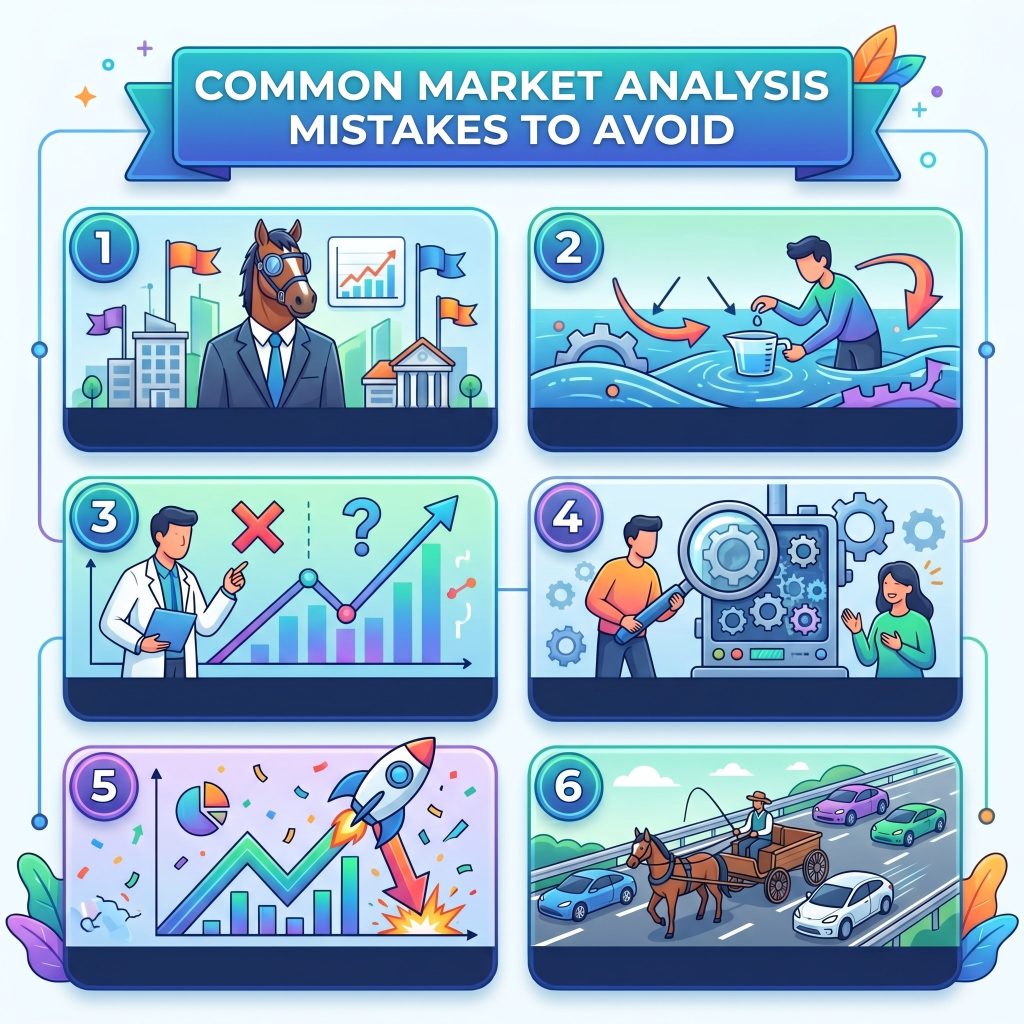 Even well-intentioned market analyses can go wrong. Here are the most common pitfalls:
Confirmation bias: Searching for data that validates what you already believe, rather than seeking an accurate picture. The goal of market analysis is truth, not validation.
Over-reliance on secondary data: Desk research has its limits. Published reports and industry data provide context, but primary research—direct customer conversations—is what generates genuine insight.
Ignoring niche segments: Focusing only on the broadest customer profile can cause you to miss high-value niches that are underserved and highly profitable.
One-time research: Markets change. A market analysis conducted two years ago may paint a very different picture from today’s reality. Build regular reviews into your strategy cycle.
Underestimating indirect competition: The most disruptive competitors often don’t look like competitors at all—until they do.
Turning Market Analysis Into Action
 Data without action is just information. The real value of market analysis emerges when you translate findings into concrete decisions.
Use customer insights to refine your product roadmap and sharpen your messaging. Use competitor analysis to identify your differentiation strategy and the specific reasons customers should choose you. Use market size and trend data to guide your resource allocation and prioritization decisions.
For businesses engaged in stock market investing or broader investment strategy, these same principles apply. Building general investment authority means understanding not just where a market is today, but where it’s heading—and why. That kind of foresight is built through consistent, rigorous market analysis, not luck.
FAQ Section
1. What is market analysis?
Market analysis is the process of researching and evaluating a market’s size, customer behavior, competitors, trends, and growth opportunities. It helps businesses make informed decisions based on data instead of assumptions.
2. Why is market analysis important for businesses?
Market analysis reduces uncertainty and risk by helping businesses understand customer needs, identify opportunities, analyze competitors, and create effective strategies for growth.
3. What are the main components of a market analysis?
A comprehensive market analysis typically includes market size, target audience, competitor analysis, industry trends, customer behavior, and external factors such as economic or regulatory changes.
4. How often should a company conduct market analysis?
Market analysis should be an ongoing process. Most businesses review their market conditions quarterly or annually, while rapidly changing industries may require more frequent analysis.
5. What is the difference between market research and market analysis?
Market research focuses on collecting data through surveys, interviews, and studies. Market analysis takes that data and interprets it to identify trends, opportunities, risks, and strategic insights.
6. How do you identify a target market?
A target market is identified by analyzing factors such as demographics, geographic location, buying behavior, interests, and customer needs. The goal is to determine which group is most likely to benefit from your product or service.
7. What tools are commonly used for market analysis?
Businesses often use tools like Google Trends, SEMrush, SimilarWeb, customer surveys, industry reports, social media analytics, and competitor websites to gather and analyze market data.
8. What is competitor analysis in market analysis?
Competitor analysis is the process of evaluating competing businesses based on their products, pricing, marketing strategies, strengths, and weaknesses to identify gaps and opportunities in the market.
9. Can small businesses benefit from market analysis?
Yes. Market analysis is valuable for businesses of all sizes. Small businesses can use it to understand customer preferences, find profitable niches, reduce risks, and compete more effectively.
Make Market Analysis a Strategic Habit—Not a One-Off Project
Market analysis is one of the highest-leverage activities a business can invest in. It closes the gap between assumptions and reality, helps you serve customers more effectively, and gives you a meaningful edge over competitors who are operating on guesswork.
Start with a defined scope. Talk to real customers. Study your competitors with genuine curiosity. Track the trends that are reshaping your industry. Then revisit those insights regularly, because the market you understood well six months ago is already changing.