Building wealth requires the right tools. For many people, a general investment account is a foundational part of their financial strategy. Unlike specialized retirement accounts or tax-wrapped savings plans, this type of account offers unparalleled flexibility. You can deposit as much money as you want, withdraw funds whenever you need them, and invest in a massive variety of assets.
Understanding how to leverage these accounts properly can significantly accelerate your financial growth. People often rely heavily on tax-advantaged accounts and forget about the freedom that comes with standard brokerage options. By exploring the broader market, you open doors to new asset classes, better liquidity, and more dynamic portfolio management.
This guide explores the exact mechanisms behind a general investment account. You will learn about the key benefits that draw investors to them, the inherent risks you need to manage, and actionable strategies to maximize your returns. By the end of this post, you will have a clear roadmap for integrating a general investment account into your broader wealth-building plan.
What is a General Investment Accounts?
A general investment account (often referred to as a standard brokerage account) is a flexible financial vehicle that allows you to buy, hold, and sell various types of investments. These can include stocks, bonds, mutual funds, exchange-traded funds (ETFs), and real estate investment trusts (REITs).
Brokerages, banks, and specialized investment firms offer these accounts. Setting one up is usually straightforward. You provide your personal information, link a funding source, and begin trading. The primary appeal lies in the lack of government-imposed restrictions. You dictate the terms of your investment timeline and capitalization.
How a general investment account works
When you open a general investment account, you deposit cash into the platform. You then use that cash to purchase securities. The broker executes these trades on your behalf, sometimes charging a commission or fee. As your investments generate dividends, interest, or capital gains, that money remains in your account. You can choose to reinvest your earnings to compound your growth or withdraw the cash to fund your lifestyle.
You retain total control over the asset allocation. If you want to build a highly aggressive portfolio composed entirely of tech stocks, you can do that. If you prefer a conservative mix of government bonds and blue-chip dividend stocks, the account accommodates that just as easily.
Key differences from tax-advantaged accounts
Most investors are familiar with tax-advantaged accounts like IRAs, 401(k)s, or ISAs (depending on your country of residence). While those accounts offer excellent tax benefits, they come with strict rules.
Governments typically limit how much money you can contribute to tax-advantaged accounts each year. They also impose heavy penalties if you withdraw your money before reaching a certain age. A general investment account has none of these boundaries. You can deposit a million dollars tomorrow and withdraw it next week without facing early withdrawal penalties. However, this freedom means your realized gains, dividends, and interest are subject to standard taxation.
Core Benefits of a General Investment Account
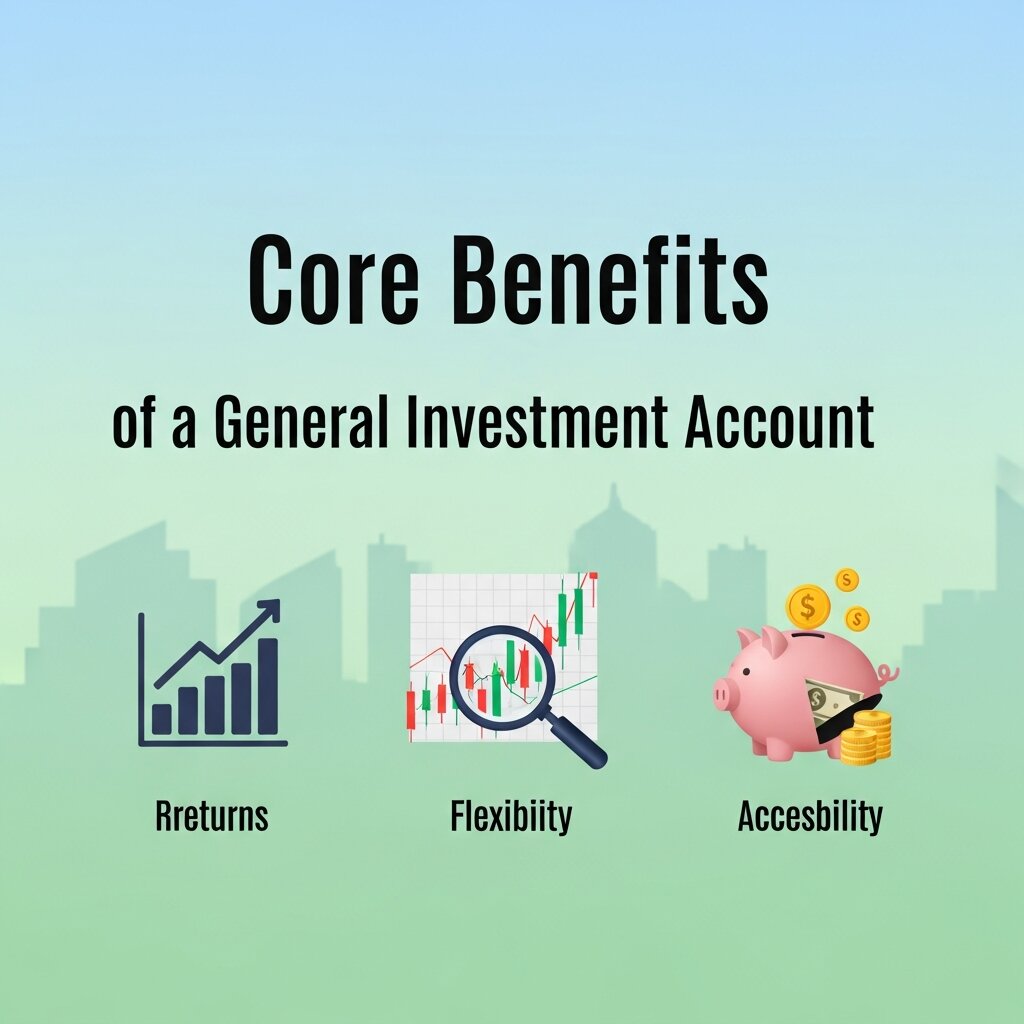 Investors flock to standard brokerage accounts for several distinct reasons. Recognizing these advantages helps you determine how much of your net worth should reside in this specific environment.
Unlimited contribution limits
Tax-advantaged accounts force high earners to look elsewhere once they hit their annual contribution caps. A general investment account solves this problem. There is absolutely no limit to the amount of capital you can funnel into general investment.
This makes it an ideal vehicle for sudden windfalls, inheritances, or the sale of a business. When you have a large sum of money that needs to be put to work immediately, a standard account absorbs the capital without any regulatory pushback.
Flexibility and accessibility
Life is unpredictable. Tying up all your assets in retirement accounts can leave you vulnerable if you need cash before you turn 59 and a half. A general investment account provides liquid capital. If you decide to buy a house, start a business, or fund a child’s education, you can liquidate your assets and access your funds within a few business days.
This liquidity provides immense peace of mind. It bridges the gap between your short-term emergency fund and your decades-long retirement strategy.
Diverse investment options
Retirement plans provided by employers often restrict you to a small menu of mutual funds. A general investment account strips away these limitations. You have access to nearly the entire global market.
You can buy fractional shares of major corporations, invest in emerging market ETFs, or purchase individual municipal bonds. This level of access allows sophisticated investors to craft highly customized portfolios that align perfectly with their specific risk tolerance and financial goals.
Potential Risks to Consider
 While the freedom of a standard brokerage account is appealing, it introduces specific challenges. Managing these risks is just as important as selecting winning stocks.
Market volatility
Because you have access to a massive universe of assets, you also have the ability to take on excessive risk. The stock market fluctuates daily based on economic data, geopolitical events, and corporate earnings.
If you invest heavily in speculative assets or fail to diversify, a market downturn can severely reduce your account balance. Unlike a savings account, your principal is never guaranteed. Understanding your own risk tolerance is crucial before allocating large sums of money.
Tax implications and capital gains
Taxes represent the biggest drag on performance in a general investment account. Every time you sell an asset for a profit, you trigger a capital gains tax event. The rate you pay often depends on how long you have held the asset. Short-term capital gains (assets held for less than a year) are usually taxed at your ordinary income rate, which can be quite high.
Additionally, you owe taxes on the dividends and interest your investments generate throughout the year, even if you reinvest them. Careful tax-loss harvesting and strategic holding periods are required to minimize this burden.
Inflation risks
Holding too much cash or investing exclusively in low-yield bonds within your account exposes you to inflation risk. If your portfolio grows at 2% per year but inflation rises at 4%, your real purchasing power is declining. You must balance the desire for safety with the need for growth to ensure your wealth outpaces the rising cost of living.
Effective General Investment Strategies
 Success in the financial markets rarely happens by accident. Implementing a structured approach protects your capital and positions you for consistent growth.
Diversification and asset allocation
Spreading your money across different asset classes is the most reliable way to reduce risk. A well-diversified general investment account might hold a mix of domestic equities, international stocks, corporate bonds, and real estate funds.
When one sector of the economy struggles, another might thrive. Proper asset allocation ensures that a single company’s bankruptcy or a regional economic downturn does not devastate your entire portfolio. You should periodically review and rebalance your account to maintain your target allocations.
Dollar-cost averaging
Trying to time the market is a losing game for most investors. Instead, employ dollar-cost averaging. This strategy involves investing a fixed amount of money at regular intervals, regardless of what the market is doing.
By investing $500 every month, you buy more shares when prices are low and fewer shares when prices are high. Over time, this smooths out the average cost of your investments and removes the emotional stress of trying to buy at the absolute bottom.
Long-term vs. short-term approaches
Define the purpose of your general investment account. If the funds are earmarked for a down payment on a house in two years, your strategy should be highly conservative. Short-term investments might focus on money market funds or short-term treasury bills to protect the principal.
Conversely, if you are building supplemental wealth for a retirement that is twenty years away, you can afford to be aggressive. A long-term horizon allows you to weather temporary market crashes and benefit from the compounding growth of equities.
Choosing the Right Brokerage for Your Needs
The platform you use to manage your general investment account directly impacts your bottom line. Take time to evaluate different brokerages before committing your capital.
Evaluating fees and commissions
Investment fees eat away at your returns over time. Fortunately, the industry has shifted toward lower costs. Many major brokerages now offer zero-commission trading for stocks and ETFs.
However, you still need to watch out for sneaky expenses. Look at the expense ratios of the mutual funds they offer. Check for account maintenance fees, inactivity fees, or charges for transferring your money to another institution. Keep your overhead as low as possible.
Platform usability and research tools
A good brokerage provides the tools you need to make informed decisions. Evaluate the platform’s user interface. Is the mobile app intuitive? Can you easily track your portfolio’s performance against major benchmarks?
Additionally, look for platforms that offer robust educational resources and research reports. Access to stock screeners, historical data, and analyst ratings can help you build a stronger general investment strategy.
Frequently Asked Questions (FAQ)
What is a general investment account?
A general investment account is a standard brokerage account that allows you to buy and sell a wide range of assets such as stocks, bonds, ETFs, and mutual funds. It offers full flexibility with no contribution limits or withdrawal restrictions, making it ideal for both short-term and long-term investing.
How is a general investment account different from a retirement account?
Unlike retirement accounts, a general investment account has no tax advantages. However, it provides complete freedom—you can deposit unlimited funds and withdraw money anytime without penalties. Retirement accounts, on the other hand, offer tax benefits but come with strict contribution limits and withdrawal rules.
Do I have to pay taxes on a general investment account?
Yes. Any profits you make, including capital gains, dividends, and interest, are subject to taxation. The amount you pay depends on your local tax laws and how long you hold your investments.
Is a general investment account safe?
The account itself is safe when held with a reputable brokerage. However, the investments inside the account carry market risk. Your returns can fluctuate based on market conditions, so diversification and risk management are essential.
Can beginners open a general investment account?
Absolutely. Most brokerages make it easy for beginners to open and manage an account. Many platforms also provide educational resources, tutorials, and simple tools to help new investors get started confidently.
What types of investments can I hold in this account?
You can invest in a wide range of assets, including stocks, bonds, ETFs, mutual funds, and REITs. This flexibility allows you to build a diversified portfolio tailored to your financial goals.
How much money do I need to start investing?
Many platforms allow you to start with a small amount, sometimes as little as $10 or $50. Thanks to fractional shares, you can invest in high-value stocks without needing large sums of money upfront.
Can I withdraw money anytime from my investment account?
Yes. One of the biggest advantages of a general investment account is liquidity. You can sell your investments and withdraw your funds whenever needed, although it may take a few business days for the transaction to settle.
Maximizing Your Financial Future
A general investment account provides the ultimate blank canvas for your financial life. It removes the guardrails of traditional retirement plans, offering you total control over how much you save, what you buy, and when you access your money.
To make the most of this tool, commit to a consistent funding schedule. Define your goals clearly so you can choose an asset allocation that makes sense for your timeline. Keep a close eye on your tax liabilities, and never stop educating yourself about the markets. By treating your standard brokerage account with the same respect and discipline as your retirement funds, you will build a resilient, flexible, and powerful financial foundation.