Few retail brands have expanded as aggressively as Dollar General. With over 19,000 stores spread across 47 states, Dollar General has become one of the most recognizable names in American retail—and increasingly, one of the most attractive opportunities in commercial real estate investing.
But what exactly does a Dollar General real estate investment look like? Who does it suit? And what are the risks you should understand before committing capital? This post breaks down everything you need to know—from how these deals are structured, to the financial profile of a typical investment, to how Dollar General stacks up against other net lease opportunities in the market.
Whether you’re a seasoned commercial real estate investor or exploring your first net lease deal, Dollar General properties offer a compelling case study in stability, income generation, and low-overhead management. Read on to find out if this investment fits your financial goals and risk tolerance.
What Is a Dollar General Net Lease Investment?
 Dollar General properties are typically sold and leased under a net lease structure, most commonly a triple-net (NNN) lease. Under this arrangement, the tenant—Dollar General—is responsible for paying property taxes, building insurance, and maintenance costs in addition to base rent. As the property owner, your role is largely passive.
This structure is what makes Dollar General properties so attractive to a specific type of investor: those who want reliable, recurring income without the day-to-day demands of property management. The landlord collects rent. Dollar General handles the rest.
Lease terms on Dollar General properties are typically 10 to 15 years at initial signing, often with multiple five-year renewal options. Rent increases, where included, are modest—usually between 5% and 10% per option period—designed to protect Dollar General’s operating margins while still offering investors some inflation protection over time.
Why Dollar General Is a Popular Choice for NNN Investors
There’s a reason Dollar General consistently appears on lists of the most-traded net lease assets in the country. Several factors combine to make these properties genuinely appealing.
Dollar General’s Business Model Is Built for Economic Uncertainty
Dollar General operates in the value retail segment—a space that historically performs well when consumer spending tightens. During economic downturns, shoppers trade down from grocery stores and big-box retailers to discount alternatives. That dynamic supported Dollar General’s growth during the 2008 financial crisis and again during the COVID-19 pandemic.
The company’s store-level economics are also notably lean. Most Dollar General locations are small-format stores (around 9,000 square feet), located in rural or suburban markets with limited competition. Low operating costs, combined with strong foot traffic from necessity-driven purchases, create a resilient revenue model for the underlying tenant.
Investment-Grade Credit Rating
Dollar General carries an investment-grade credit rating, which matters significantly in net lease investing. When a tenant holds investment-grade credit, it signals to lenders and investors alike that the company is financially stable and unlikely to default on its lease obligations. For investors focused on income reliability, that rating is a meaningful risk management tool.
High Demand, Strong Liquidity
Because Dollar General NNN properties are widely recognized, they tend to have strong secondary market liquidity. When it comes time to sell, you’re not marketing an obscure asset to a narrow buyer pool—you’re selling into a well-established market where institutional and private buyers regularly compete for deals.
What Are the Typical Financials of a Dollar General Investment?
Understanding the numbers is essential before evaluating any Dollar General real estate investment.
Cap Rates
Capitalization rates (cap rates) on Dollar General properties typically range from 5% to 7%, depending on factors like location, lease term remaining, and whether the property is a newer prototype or an older build. Properties in high-traffic suburban markets with long lease terms tend to trade at lower (more compressed) cap rates, reflecting higher demand. Rural locations with shorter lease terms may offer higher cap rates—and higher perceived risk.
Purchase Price Range
Dollar General properties typically trade between $1.2 million and $2.5 million, though pricing varies considerably by market and lease structure. Some higher-demand markets have seen pricing push above that range, compressing cap rates further.
Loan-to-Value and Financing
Because Dollar General is an investment-grade tenant, lenders tend to offer favorable financing terms on these properties. Loan-to-value ratios of 65% to 75% are common, and interest rates are generally competitive compared to other commercial real estate asset types. That financing availability is a meaningful advantage for investors looking to leverage their capital.
What Are the Risks of Dollar General Real Estate Investing?
 No investment is without risk, and dollar general real estate investment opportunities are no exception. Understanding the downside scenarios is just as important as appreciating the upside.
Lease Expiration and Renewal Uncertainty
Dollar General typically holds renewal options—but those options belong to the tenant, not the landlord. If Dollar General determines a location is underperforming, it has the right to walk away at lease expiration. In rural markets with limited alternative tenants, that outcome could leave a landlord with a vacant, purpose-built retail building that is difficult to re-lease or sell.
This is one of the core reasons why location quality should be a primary filter in your investment decision. A Dollar General in a growing suburban market carries meaningfully different risk than one in a declining rural town.
Rent Escalation May Lag Inflation
While some Dollar General leases include rent bumps, many older leases are flat—meaning rent stays fixed for the entire primary term. In periods of elevated inflation, the real purchasing power of that income erodes over time. Investors with strong inflation sensitivity should scrutinize lease terms carefully and prioritize deals that include scheduled escalations.
Corporate Strategy and Store Closures
Dollar General has announced periodic store rationalization efforts as part of its broader operational strategy. While closures remain a small fraction of its total footprint, the risk of a specific location being targeted for closure does exist. Monitoring Dollar General’s corporate communications and real estate pipeline decisions is a useful part of ongoing investment risk management for landlords with multiple Dollar General assets.
Limited Upside on Asset Appreciation
Net lease properties are fundamentally income vehicles. Unlike multifamily or value-add commercial assets, there’s limited opportunity to force appreciation through operational improvements. The asset’s value is largely a function of the lease terms, tenant credit, and prevailing cap rates—factors largely outside your control. Investors seeking significant capital appreciation may find the net lease model too passive for their goals.
Dollar General vs. Other Net Lease Opportunities: How Does It Compare?
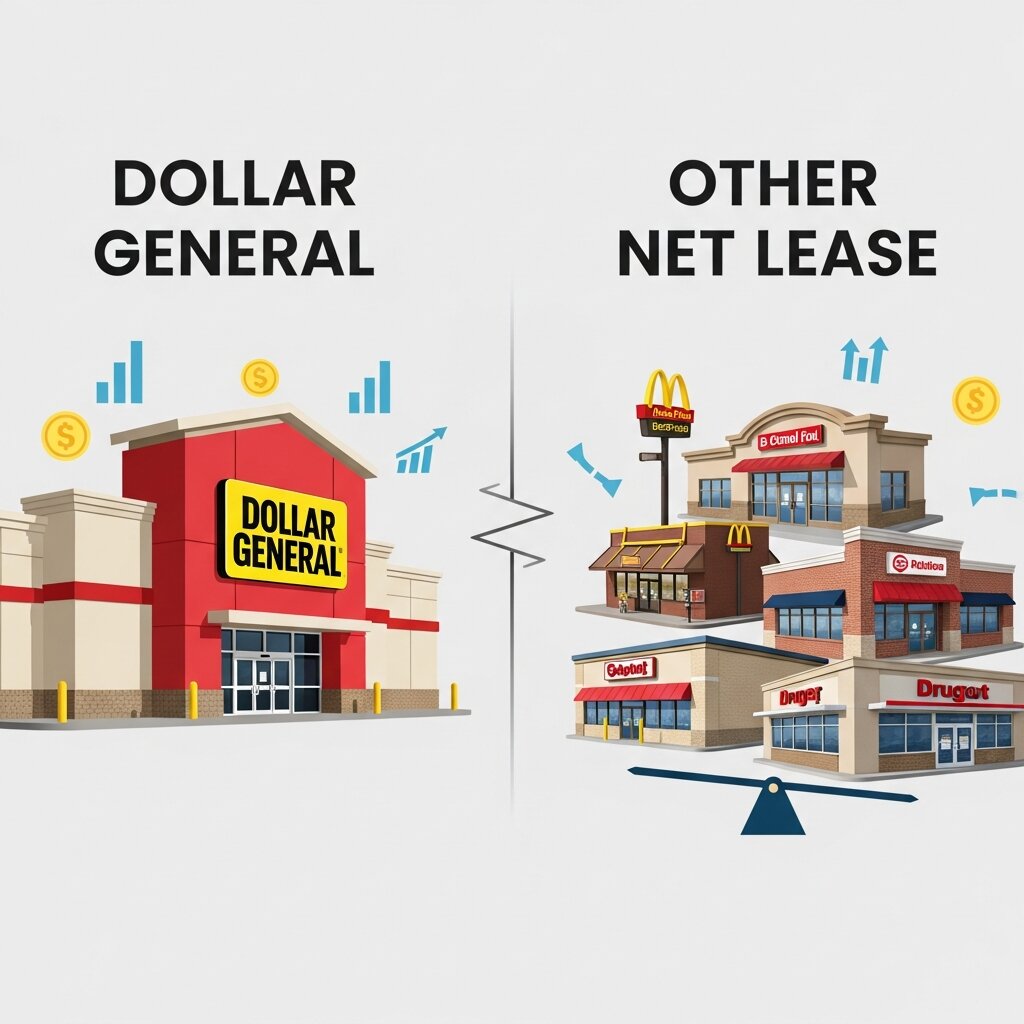 Dollar General competes for investor capital alongside other major NNN retail tenants—Dollar Tree, Family Dollar, AutoZone, O’Reilly Auto Parts, and fast food brands like McDonald’s or Starbucks.
Compared to fast food net leases, Dollar General properties typically offer higher cap rates (better initial yield) but with somewhat less tenant covenant strength and shorter remaining lease terms at the time of acquisition. Fast food ground leases—where you own the land but not the building—tend to trade at premium prices reflecting the perceived security of those tenants.
Compared to other dollar store concepts like Dollar Tree and Family Dollar (both owned by Dollar Tree, Inc.), Dollar General’s standalone corporate financials and track record of growth give it a slight edge in perceived credit quality. Family Dollar in particular has faced operational challenges that have been well-documented in its parent company’s earnings reports.
For investors whose primary goal is income stability and risk management, Dollar General sits in a genuinely competitive position within the net lease universe—particularly at the price points available to private investors.
How to Find and Evaluate Dollar General Investment Properties
Dollar General properties are widely listed through commercial real estate brokers specializing in net lease assets. Platforms like LoopNet, CoStar, and specialized net lease brokers (such as The Boulder Group or Stan Johnson Company) regularly list available Dollar General properties across the country.
When evaluating a specific deal, consider the following:
- Remaining lease term: Longer is better. A deal with 12+ years remaining offers more income visibility than one with four years left.
- Rent escalations: Identify whether the lease includes scheduled rent bumps, and if so, how frequently and at what percentage.
- Location demographics: Population trends, household income levels, and proximity to competing discount retailers all affect long-term viability.
- Store vintage: Newer Dollar General prototype stores (DG Fresh, DGX, or standard new builds) are generally preferred over older, smaller locations that may be harder to re-lease.
- Corporate vs. franchise: All Dollar General stores are corporate-operated, which simplifies credit analysis compared to franchised concepts where you’d need to evaluate the individual franchisee.
Due diligence on these deals is relatively straightforward compared to other commercial real estate asset types, which is another reason they attract investors who are transitioning away from active management.
Is Dollar General Real Estate Right for Your Portfolio?
Dollar General real estate investment appeals most strongly to investors who prioritize passive income, value tenant credit quality, and are comfortable with limited upside on asset appreciation. It’s a particularly strong fit for investors who are rolling over capital from active investments—rentals, business sales, or stock market investing proceeds—into a more passive vehicle.
Your personal risk tolerance should guide the decision. If you require strong inflation protection or expect to need significant appreciation over a short hold period, the fixed-income nature of a net lease may not align with your goals. However, if reliable monthly income, minimal management burden, and a recognizable corporate tenant are what you’re after, Dollar General properties are worth serious consideration.
The best dollar general real estate investment decisions are made by investors who understand both the structural advantages of NNN leases and the specific dynamics of this tenant—not those who are simply drawn to the passive income narrative without looking at the underlying numbers.
Frequently Asked Questions
Is Dollar General real estate a good investment?
Dollar General real estate can be a good investment for those seeking passive rental income through a net lease structure. However, investors should evaluate location, lease term, rent escalations, purchase price, tenant credit, and potential vacancy risks before investing.
How does a Dollar General NNN lease work?
A Dollar General NNN lease generally requires the tenant to cover property taxes, insurance, and maintenance costs in addition to base rent. This reduces the landlord’s operating responsibilities and makes the investment relatively passive.
What is the typical cap rate for a Dollar General property?
Dollar General properties can trade at different cap rates depending on location, lease term, property condition, and market conditions. Investors should compare the asking cap rate with comparable NNN properties and assess the risks behind the yield.
What are the biggest risks of Dollar General real estate investing?
Major risks include lease expiration, store closures, limited rent increases, inflation, changing consumer demand, and difficulty re-leasing a vacant property. Location quality and remaining lease term are especially important when assessing downside risk.
Can Dollar General properties generate passive income?
Yes. A properly structured NNN Dollar General property can provide relatively passive rental income because the tenant typically handles many property-level expenses and responsibilities. Investors still need to monitor the lease, tenant performance, and overall asset value.
How long are Dollar General property leases?
Dollar General leases are commonly structured with long initial terms, often around 10 to 15 years, with renewal options. Exact terms vary by property, so investors should review the actual lease rather than relying on typical market structures.
What should investors look for in a Dollar General property?
Investors should examine the remaining lease term, rent escalations, store performance, local demographics, traffic patterns, competition, property condition, purchase price, cap rate, and the likelihood of finding another tenant if Dollar General leaves.
Can a Dollar General property lose value?
Yes. Property values can decline if interest rates rise, cap rates expand, the lease approaches expiration, the location becomes less attractive, or Dollar General vacates the property. Strong tenant credit does not eliminate property-level investment risk.
The Bottom Line on Dollar General Real Estate Investing
Dollar General has built one of the most durable retail footprints in the country, and that footprint has created a steady pipeline of investable net lease assets. The combination of investment-grade credit, long initial lease terms, and low management requirements makes these properties genuinely attractive for income-focused investors.
That said, location selection, lease structure, and remaining term are critical variables that separate a good deal from a mediocre one. Investors who apply rigorous due diligence—rather than buying on brand name recognition alone—are far better positioned to build a Dollar General real estate portfolio that delivers consistent returns over time.