
Every business decision carries a question about the future. Should you hire three more people next quarter? Can you afford to expand into a new market? What happens to cash flow if a major client pays late? Financial forecasting helps you answer these questions with confidence instead of guesswork.
A good forecast turns scattered numbers into a clear picture of where your company is headed. It guides spending, shapes hiring plans, and tells investors you know your business inside and out. Yet many owners treat forecasting as a once-a-year chore, or skip it entirely.
This guide breaks down the financial forecasting strategies that matter most. You’ll learn the core methods, how to fold in market analysis and risk tolerance, and how to build a process you can actually maintain. Whether you run a startup or manage finances at an established firm, these strategies will help you plan smarter and react faster.
What Is Financial Forecasting?
Financial forecasting is the process of estimating your company’s future financial performance based on historical data, current trends, and reasonable assumptions. In plain terms, it’s an educated prediction of how much money will come in, how much will go out, and what your financial position will look like down the road.
Forecasts usually cover three core statements: the income statement, the cash flow statement, and the balance sheet. Together, these show projected revenue, expenses, profit, and the resources your business will have on hand.
It helps to separate forecasting from budgeting. A budget sets targets you want to hit. A forecast estimates what’s likely to happen, whether you like the result or not. The two work best as a pair: the budget sets the goal, and the forecast tells you whether you’re on track to reach it.
Why Financial Forecasting Matters
 Forecasting does more than fill a spreadsheet. It gives you a tool to steer the business.
- Better cash flow management. A forecast warns you about cash shortfalls before they hit, giving you time to arrange credit or trim spending.
- Smarter decisions. When you can see the financial impact of a choice ahead of time, you avoid expensive surprises.
- Stronger funding applications. Lenders and investors expect realistic projections. A solid forecast shows you understand the numbers driving your business.
- Clearer goals. Forecasts give your team concrete targets and a way to measure progress.
Companies that forecast regularly tend to spot problems earlier and recover faster when conditions shift. That advantage compounds over time.
Core Financial Forecasting Methods
There’s no single right way to forecast. Most businesses use a blend of methods, choosing the approach that fits the question they’re trying to answer.
Quantitative Forecasting
Quantitative methods rely on historical data and math. They work best when you have a solid record of past performance and conditions are fairly stable.
- Straight-line forecasting applies a fixed growth rate to past figures. If revenue grew 8% last year, you project the same rate forward. It’s simple and quick, though it ignores seasonal swings and market shifts.
- Moving average smooths out short-term noise by averaging results over several periods. This is handy for businesses with choppy month-to-month sales.
- Regression analysis measures how one variable affects another, such as how advertising spend influences sales. It’s more complex but reveals relationships you might otherwise miss.
Qualitative Forecasting
When you lack historical data, such as during a launch or a major pivot, qualitative methods step in. These lean on expert judgment, market research, and industry knowledge rather than raw numbers.
This approach suits new products, fast-changing markets, and long-range planning where past data offers little guidance. The trade-off is subjectivity, so it pays to gather input from several informed sources rather than relying on a single opinion.
Driver-Based Forecasting
Driver-based forecasting links your projections to the key activities that actually move your numbers. Instead of guessing at total revenue, you model the drivers behind it: number of customers, average order value, conversion rate, and so on.
This method is powerful because it ties financial outcomes to operational decisions. Want to know what happens if you boost your conversion rate by two points? A driver-based model shows you instantly.
Building Market Analysis Into Your Forecast
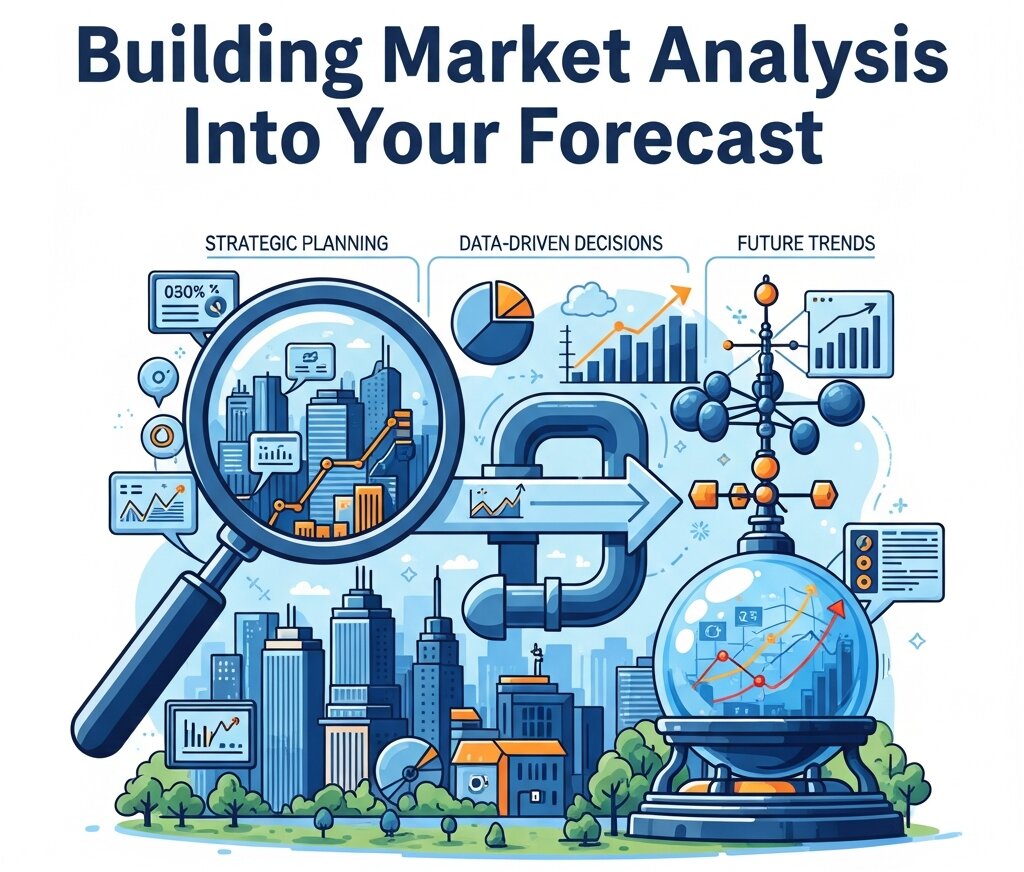 Your numbers don’t exist in a vacuum. Strong market analysis keeps your forecast grounded in reality rather than wishful thinking.
Start by examining demand trends in your industry. Is your market growing, shrinking, or holding steady? Public reports, trade associations, and government data often provide reliable figures you can fold into your assumptions.
Next, study your competitors. A new rival cutting prices, or an established player exiting the market, can reshape your revenue outlook quickly. Factor these moves into your projections instead of assuming the landscape stays frozen.
Finally, watch the wider economy. Interest rates, inflation, and consumer confidence all ripple through to your bottom line. A forecast built on careful market analysis adjusts for these forces rather than ignoring them. The result is a projection your team and your investors can trust.
Managing Risk and Uncertainty
No forecast is perfect. The goal isn’t to predict the future exactly, but to prepare for a range of outcomes. This is where understanding your risk tolerance becomes essential.
Scenario Planning
Rather than betting everything on one set of numbers, build several versions of your forecast:
- Best case assumes strong sales and favorable conditions.
- Base case reflects your most realistic expectations.
- Worst case plans for setbacks like lost clients or rising costs.
Comparing these scenarios shows you how much room for error you have. It also helps you decide how aggressively to spend or invest given your appetite for risk.
Sensitivity Analysis
Sensitivity analysis tests how changes in a single assumption affect your results. What happens to profit if material costs jump 15%? What if your biggest customer leaves? By isolating each variable, you learn which factors your business is most exposed to and where to focus your attention.
Matching Strategy to Risk Tolerance
Every business has a different appetite for risk. A young startup chasing growth may accept volatile projections, while a family-owned firm may prefer caution and steady margins. Knowing your risk tolerance shapes how conservative your forecast should be and how much cushion you build into your plans.
Connecting Forecasting to Asset Allocation
Forecasting and asset allocation go hand in hand. Once you understand where your cash flow is heading, you can decide how to deploy your resources wisely.
Asset allocation is about spreading your funds across different uses to balance growth and safety. For a business, that might mean splitting resources between operating reserves, equipment, inventory, and longer-term investments. A reliable forecast tells you how much you can commit to each without straining day-to-day operations.
For example, if your forecast shows a strong cash surplus over the next two quarters, you might allocate part of it toward expansion or technology upgrades. If it signals a tight stretch ahead, you’d hold more in reserve. Tying asset allocation to your forecast keeps your spending aligned with your real financial position, not your hopes.
This discipline also protects you from overextending. Many businesses fail not because they lack profit, but because they run out of cash at the wrong moment. A forecast that informs your asset allocation guards against that trap.
Practical Steps to Improve Your Forecasting Process
Knowing the methods is only half the battle. A reliable forecasting process depends on good habits and the right routine.
- Gather clean data: Your forecast is only as good as the numbers behind it. Keep accurate, up-to-date records of revenue, expenses, and cash flow.
- Pick the right time horizon: Short-term forecasts (weeks to months) help with cash management. Long-term forecasts (one to five years) guide strategy and investment.
- Update regularly: Treat your forecast as a living document. Revisit it monthly or quarterly and adjust as new information arrives.
- Compare forecast to actual results: After each period, check how your predictions held up. The gaps reveal where your assumptions need refining.
- Use the right tools: Spreadsheets work for simple needs, but dedicated forecasting software handles complex models and scenario planning with far less effort.
- Involve your team: Sales, operations, and finance each hold pieces of the puzzle. Pulling in their input produces a fuller, more accurate forecast.
The businesses that forecast best aren’t the ones with the fanciest models. They’re the ones who review and refine their forecasts consistently.
Technology and AI in Financial Forecasting
 Modern financial forecasting is no longer limited to spreadsheets and manual calculations. Advances in technology—especially AI and machine learning—have transformed how businesses predict future performance. AI-powered forecasting tools can analyze large datasets in seconds, identifying patterns that humans might miss. For example, they can detect subtle seasonal trends, predict customer churn, or adjust revenue projections based on real-time sales data. This makes forecasts more dynamic and responsive rather than static snapshots.
Cloud-based platforms also allow teams to collaborate on forecasts in real time. Instead of working in isolation, finance, sales, and operations teams can update assumptions, test scenarios, and immediately see how changes affect the overall model. However, technology is only as good as the data behind it. Poor-quality or incomplete data will still lead to inaccurate forecasts, even with advanced tools. That’s why businesses should combine automation with strong data governance and human oversight to ensure reliability.
Common Financial Forecasting Mistakes to Avoid
Even with the right tools and methods, forecasting can go wrong if certain pitfalls are ignored. One of the most common mistakes is being overly optimistic. Many businesses assume steady growth without accounting for market slowdowns, competition, or internal constraints. Another frequent issue is relying too heavily on a single scenario. A “one-line forecast” ignores uncertainty and can leave a business unprepared when reality shifts. Without best-case and worst-case planning, decision-making becomes fragile.
Inconsistent updates are also a major problem. A forecast that is created once and never revisited quickly becomes outdated. As market conditions change, so should your assumptions and projections. Finally, many businesses overlook small but critical drivers such as customer retention rates, pricing changes, or delayed payments. Ignoring these details can significantly distort results over time. Avoiding these mistakes helps ensure your forecast remains realistic, actionable, and useful for day-to-day decision-making.
Frequently Asked Questions (FAQ)
1. What is financial forecasting?
Financial forecasting is the process of estimating a company’s future financial performance based on historical data, current trends, and business assumptions. It helps organizations predict revenue, expenses, cash flow, and profitability to support strategic decision-making.
2. Why is financial forecasting important for businesses?
Financial forecasting helps businesses plan for growth, manage cash flow, allocate resources effectively, identify potential risks, and make informed financial decisions. It also provides valuable insights for investors, lenders, and stakeholders.
3. What is the difference between a financial forecast and a budget?
A budget sets financial goals and spending limits for a specific period, while a financial forecast estimates what is likely to happen based on current conditions and available data. Forecasts are typically updated more frequently to reflect changing circumstances.
4. What are the main types of financial forecasting methods?
Common forecasting methods include quantitative forecasting, qualitative forecasting, and driver-based forecasting. Businesses often combine multiple methods to improve accuracy and account for different variables.
5. How does market analysis improve financial forecasting?
Market analysis provides insights into industry trends, customer demand, competitor activity, and economic conditions. Incorporating this information helps businesses create more realistic and reliable financial projections.
6. What is driver-based forecasting?
Driver-based forecasting focuses on the key factors that influence financial performance, such as customer acquisition rates, average transaction values, pricing strategies, and operational efficiency. This approach creates forecasts that are closely linked to business activities.
7. What is scenario planning in financial forecasting?
Scenario planning involves creating multiple forecasts based on different assumptions, such as best-case, worst-case, and most likely outcomes. It helps businesses prepare for uncertainty and make better strategic decisions.
8. How does risk tolerance affect financial forecasting?
Risk tolerance determines how conservative or aggressive a forecast should be. Businesses with a lower tolerance for risk may use cautious assumptions, while organizations focused on rapid growth may be comfortable with more ambitious projections.
9. What role does asset allocation play in financial planning?
Asset allocation helps businesses decide how to distribute financial resources among cash reserves, investments, equipment, inventory, and growth initiatives. Effective allocation ensures resources are aligned with projected financial needs and business goals.
10. How often should a financial forecast be updated?
Most businesses should review and update forecasts monthly or quarterly. Regular updates ensure projections remain accurate and reflect changes in market conditions, business performance, and economic trends.
Putting Your Forecasting Strategy Into Action
Financial forecasting isn’t a crystal ball, but it’s the closest thing a business has to one. By combining quantitative and qualitative methods, grounding your numbers in market analysis, and planning for risk based on your tolerance, you build a clearer view of what lies ahead. Tie that view to thoughtful asset allocation, and you turn raw projections into smarter decisions.
Start small if you need to. Pick one method, build a simple model for the next quarter, and compare it against your actual results. Refine your assumptions, widen your time horizon, and add scenario planning as your confidence grows. Over time, forecasting shifts from a yearly scramble into a steady habit that sharpens every decision you make.